Pointers in C
Introduction to C Pointers
A Pointer in C language is a variable which holds the address of another variable of same data type.
Pointers are used to access memory and manipulate the address.
Pointers are one of the most distinct and exciting features of C language. It provides power and flexibility to the language. Although pointers may appear a little confusing and complicated in the beginning, but trust me, once you understand the concept, you will be able to do so much more with C language.
Before we start understanding what pointers are and what they can do, let's start by understanding what does "Address of a memory location" means?
Address in C
Whenever a variable is defined in C language, a memory location is assigned for it, in which it's value will be stored. We can easily check this memory address, using the
& symbol.
If
var is the name of the variable, then &var will give it's address
Let's write a small program to see memory address of any variable that we define in our program.
#include<stdio.h>

void main()
{
    int var = 7;
    printf("Value of the variable var is: %d\n", var);
    printf("Memory address of the variable var is: %x\n", &var);
}
Value of the variable var is: 7
Memory address of the variable var is: bcc7a00
You must have also seen in the function
scanf(), we mention &var to take user input for any variable var.scanf("%d", &var);
This is used to store the user inputted value to the address of the variable
var
Concept of Pointers
Whenever a variable is declared in a program, system allocates a location i.e an address to that variable in the memory, to hold the assigned value. This location has its own address number, which we just saw above.
Let us assume that system has allocated memory location
80F for a variable a.int a = 10;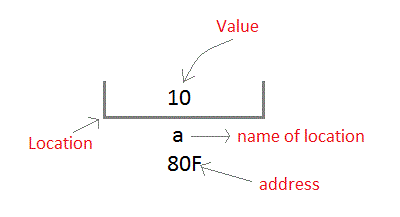
We can access the value
10 either by using the variable name a or by using its address 80F.
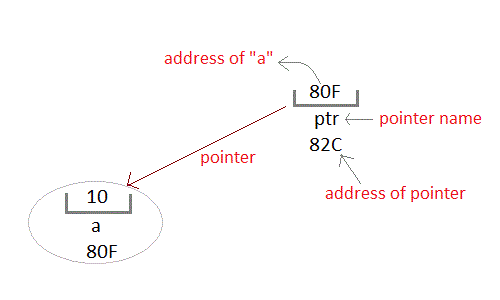
The question is how we can access a variable using it's address? Since the memory addresses are also just numbers, they can also be assigned to some other variable. The variables which are used to hold memory addresses are called Pointer variables.
A pointer variable is therefore nothing but a variable which holds an address of some other variable. And the value of a pointer variable gets stored in another memory location.
Benefits of using pointers
Below we have listed a few benefits of using pointers:
- Pointers are more efficient in handling Arrays and Structures.
- Pointers allow references to function and thereby helps in passing of function as arguments to other functions.
- It reduces length of the program and its execution time as well.
- It allows C language to support Dynamic Memory management.
In the next tutorial we will learn syntax of pointers, how to declare and define a pointer, and using a pointer. See you in the next tutorial.
Declaring, Initializing and using a pointer variable in C
In this tutorial, we will learn how to declare, initialize and use a pointer. We will also learn what NULL pointer are and where to use them. Let's start!
Declaration of C Pointer variable
General syntax of pointer declaration is,
datatype *pointer_name;
Data type of a pointer must be same as the data type of the variable to which the pointer variable is pointing.
void type pointer works with all data types, but is not often used.
Here are a few examples:
int *ip     // pointer to integer variable
float *fp;      // pointer to float variable
double *dp;     // pointer to double variable
char *cp;       // pointer to char variable
Initialization of C Pointer variable
Pointer Initialization is the process of assigning address of a variable to a pointer variable. Pointer variable can only contain address of a variable of the same data type. In C language address operator
& is used to determine the address of a variable. The & (immediately preceding a variable name) returns the address of the variable associated with it.#include<stdio.h>
void main()
{
int a = 10;
int *ptr; //pointer declaration
ptr = &a; //pointer initialization
}
Pointer variable always point to variables of same datatype. Let's have an example to showcase this:
#include<stdio.h>

void main()
{
    float a;
    int *ptr;
    ptr = &a;       // ERROR, type mismatch
}
If you are not sure about which variable's address to assign to a pointer variable while declaration, it is recommended to assign a
NULL value to your pointer variable. A pointer which is assigned a NULL value is called a NULL pointer.#include <stdio.h>
int main()
{
int *ptr = NULL;
return 0;
}Using the pointer or Dereferencing of Pointer
Once a pointer has been assigned the address of a variable, to access the value of the variable, pointer is dereferenced, using the indirection operator or dereferencing operator
*.#include <stdio.h>
int main()
{
int a, *p; // declaring the variable and pointer
a = 10;
p = &a; // initializing the pointer
printf("%d", *p); //this will print the value of 'a'
printf("%d", *&a); //this will also print the value of 'a'
printf("%u", &a); //this will print the address of 'a'
printf("%u", p); //this will also print the address of 'a'
printf("%u", &p); //this will print the address of 'p'
return 0;
}Points to remember while using pointers
- While declaring/initializing the pointer variable,
*indicates that the variable is a pointer. - The address of any variable is given by preceding the variable name with Ampersand
&. - The pointer variable stores the address of a variable. The declaration
int *adoesn't mean thatais going to contain an integer value. It means thatais going to contain the address of a variable storing integer value. - To access the value of a certain address stored by a pointer variable,
*is used. Here, the*can be read as 'value at'.
Time for an Example!
Let's take a simple code example,
#include <stdio.h>

int main()
{
    int i = 10;     // normal integer variable storing value 10
    int *a;     // since '*' is used, hence its a pointer variable

    /*
        '&' returns the address of the variable 'i'
        which is stored in the pointer variable 'a'
    */
    a = &i;

    /*
        below, address of variable 'i', which is stored
        by a pointer variable 'a' is displayed
    */
   printf("Address of variable i is %u\n", a);

    /*
        below, '*a' is read as 'value at a'
        which is 10
    */
   printf("Value at the address, which is stored by pointer variable a is %d\n", *a);

   return 0;
}
Address of variable i is 2686728 (The address may vary)
Value at an address, which is stored by pointer variable a is 10
Comments
Post a Comment